Hams - VK9NS - Jim Smith
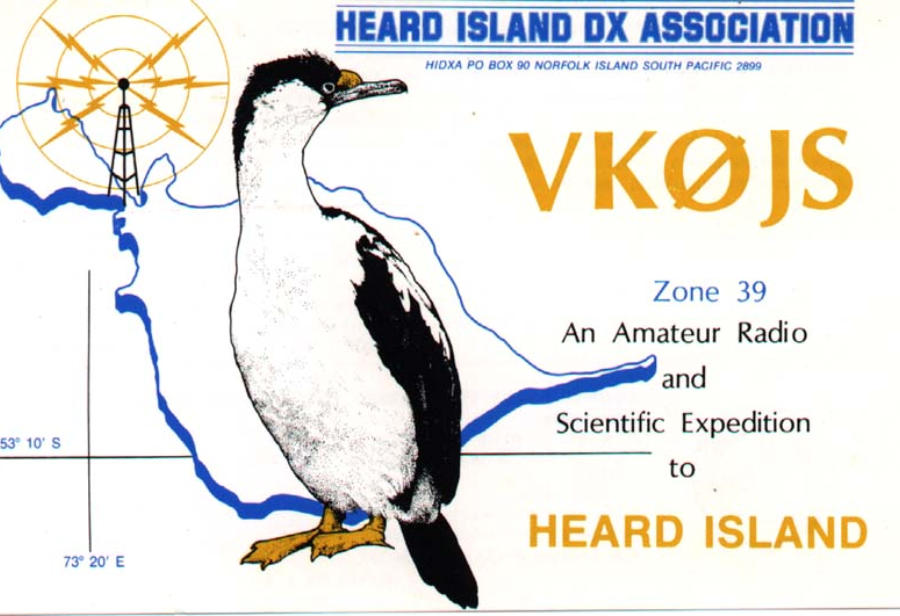
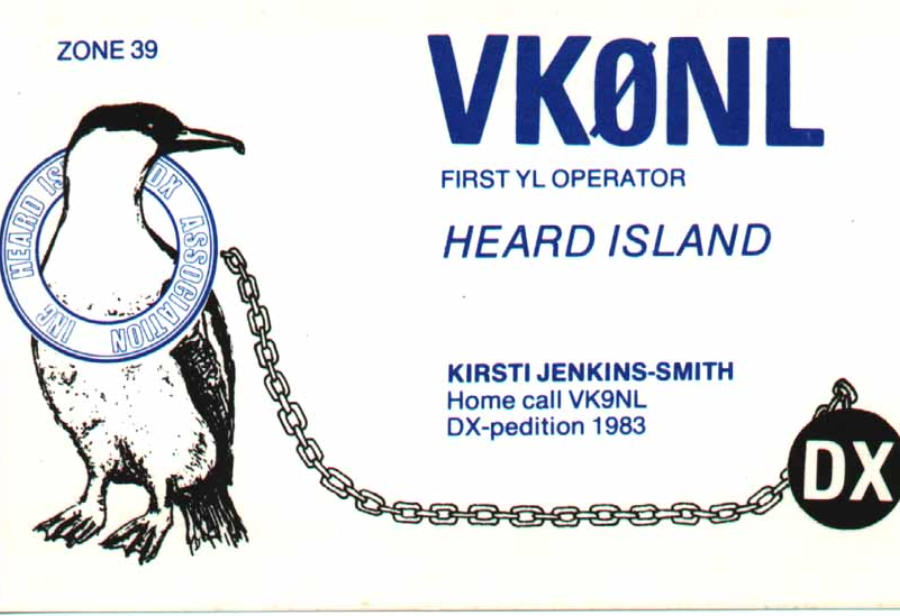
Heard Island, VK0JS and VK0NL (1983)
No regulations were in place for a private expedition to Heard Island when Jim first started thinking
about the lack of amateur radio there and decided to do something about it. Before any concrete
plans could be made, he had to get permission from the Australian authorities; something which
necessitated a visit to Canberra. Here Jim met with
officers from the relevant Government department and
between them they made the appropriate rules and
regulations to enable ‘private visits’ to Heard Island to
take place - not only for H.I.DX.A., but for all other
private expeditions in the future.
It was to be another three years before H.I.DX.A. had
everything in place: The ship was a former whale
chaser, the S/S CHEYNES II and food and stores, radio
equipment and antennas etc. etc. were ready to be
loaded onboard. A number of other interest groups had
been signed up to take part, and expeditioners,
including mountaineers from Austria and Australia,
scientists from Australia and radio amateurs from
Norfolk Island, U.S.A. Austria and Holland, and a
professional Australian filmcrew of two, gathered in
Hobart, Tasmania just after New Year 1983. To keep the
cost of the charter down, all expeditioners were to cook
and stand watches along with the ship's seven man
crew, during the voyage which was expected to take
about seven days.
As it turned out, there were many problems with the
apparent ship's fuel consumption and, what with having
had to return to Hobart, then later having to make a
detour to Albany in Western Australia and a further unscheduled stop at Kerguelen Island in the
South Indian Ocean, the expedition did not reach Heard Island until 5th of February 1983.
Once on Heard Island, work went ahead and VK0JS
was on the air that same evening.
The operators, Jim, VK9NS; Bob, WA8MOA; Walter,
OE1LO; and SoJo, VK0SJ used the station call VK0JS
while Kirsti, VK9NL used the call VK0NL as this was a
new YL country. Two metal huts left over by French
scientists were used as accommodation with one
housing the non-radio people and the smaller one given
over to sleeping quarters and operating positions for
the radio amateurs.
And so the days passed. Heard Island was available on
the amateur radio bands, the scientists went about their business of collecting specimens and doing
tests, the mountaineers set off to climb Big Ben on a difficult and challenging route, and the journalist
and cameraman were everywhere filming the animal life and everything else that moved.
Life was not exactly easy, but it was interesting. The
resultant film was called ‘The Ship that shouldn’t have.”
Once back onboard the Cheynes II life became even
more interesting when it became clear that the ship did
not have enough fuel to get back to Australia. But all
was not lost. H.I.DX.A. carried some tarpaulins as
spare accommodation in case all the huts on the Island
had been ruined. These could now be made into
improvised sails and the ship was to literally sail
through the Roaring Forties back to Australia.
A dismal time followed the shutting down of the engines
with expeditioners all doing their stint of watch-keeping
and steering the ship by hand on the open afterdeck.
No engine, no electricity except for a few hours in the
early evening to keep the refrigerator and navigational
instruments going. This was provided by a small
generator on deck. The ship was damp and cold. Food
was short and water was severely rationed. But the
expeditioners all kept their spirit up and what could have
become a nasty situation, passed by remarkably
smoothly. The S.S Cheynes II arrived back in Albany
16th March 1983. She had then been under "sail" for a
total of 16 days, under steam for three days and under tow for eight days.
The raw statistics read the 2,242 n. mile trip form
Heard Island to Albany W.A.) took 27 days. The vessel
was ‘sailed’ a total of 855 nautical miles in 368 hours at
an average speed of 2.32 knots. The vessel steamed
for a total of some 811 n. miles and was then towed for
the remainder of the journey. Surely the trip is an epic
in its own right.
Kirsti later wrote a book about this truly remarkable
expedition to one of the World's outposts: ‘HEARD
ISLAND ODYSSEY.’ The book tells the complete story
of the perilous Heard Island DXpedition to this remote
and uninhabited island aboard an old whale chaser, the Cheynes II which had been chartered for the
voyage in 1983. It shows how the vessel’s crew and expeditioners alike overcame the many
problems which became evident as the ship steamed south through the ‘roaring 40’s.’ It was,
however, the voyage home which would seriously test their mettle. Many of the photos contained in
the book, are surely unique in the annals of seafaring.
(The book (217 pages) is now a collectors item).