It all began when I had been told by the people from the
Farrell Lines, formerly the American South African Lines
we came over on, that I would have to wait about a
month to get a ship back to the USA. So when Oboler offered me a job under the University of California
African Expedition headed by Wendell Phillips’ banner, I took it for just a short stay.
I wasn’t really certain I was completely free of the Gatti-Hallicrafters contractual influence, so Arch said,
“Come with me for a couple of weeks while we find out if you can be completely free of Gatti. I need a
technician to run my tape recorders, and maybe shoot some film. I was supposed to get these services from
the University expedition, but George Russell tells me a story that scares me quite a bit. I’d rather not be
dependant on the expedition.”
When the American consul and I had first met Oboler on the ship, I told the radio playwright the Gatti firing
me story in all its splendor. Captain Russell right away told Arch what Wendell Phillips was really like in no
uncertain terms, and ended it by saying, “If I were you, Arch, I would not join the University of Cal expedition.
Phillips is promoter a lot like Gatti.”
So when the trailer that Arch had brought with him on the ship was unloaded, Russell came by the dock with
his US Army weapons carrier truck and hooked onto the cute little house trailer. With our baggage in the
back of the truck, the three of us, George, Arch and Bill, started out for Nairobi, 330 (ok) miles from
Mombasa. The first 20 miles or so were nice smooth asphalt surface, and the weather was good, so we
merrily headed for the two day trip to the capital.
I was pretty well acquainted with George by then, because while we were waiting for Arch to arrive, we had
bent the elbow a couple times in the local hotel bars. The fact that I was Signal Corps reserve captain in the
US Army helped to solidify our friendship. We shared our war stories.
When we headed out of Mombasa headed towards Nairobi, George was driving the truck, Arch was seated
in the other front seat, and I was seated on the outside of the body I can’t seem to remember what I sat on,
but it was either a battery box or tool box out in the wind, because I had to hang on to something to keep
from falling off. But in the hot sunshine, it was cooler there than in the back of the canvas covered cargo
space on the truck.
As we left Mombasa, the three of us were singing a parody of Judy Garland’s song “We’re off to see the
Wizard, the wonderful wizard of Oz.” We were laughing and singing as we made a good 35 miles and hour
on the smooth roadway, and we were all trying to make up parody verses to the Oz song as we went rolling
along. The poetry of the lyrics left something to be desired, but it was fun. You would never have the so-
called Italian commander in a scene like we were living at that moment. He would have been back in his tent
sending nasty Gatti-grams to the chorus.
I came up with a parody verse which went something like this: “I’m off to leave that lizard, a phoney explorer
called Gat.”
When the asphalt roadway ended, the rippling washboard board road began. It was only slightly wider than
one lane, and composed mostly of red dirt. The ripples in the road added ripple modulation to our occasional
parody singing.
Our speed now dropped down to less than 20 miles an hour. Having driven a Gatti truck on the Kenyan
roads, I was well acquainted with the things they called “roads. or highways.” There was not a lot of traffic; in
fact in those days, there were no big trucks, the railway got most all of that commerce. There was, however,
an occasionally heavily over-loaded bus with natives riding even on the top of the bus with their baggage,
bouncing down the road. I hated to meet one of them at any time, as we had to go slightly off the highway to
meet them without a crash.
It wasn’t long before Oboler changed his tune, and wanted to see how the trailer was riding on the bouncy,
washboardy road. I don’t think we had gone another 40 miles when we stopped and Oboler opened the door
of his trailer. He quietly stood there surveying the interior. The interior was shambles. The big mirror on the
back of a door was shattered, pieces of mirror glass were covering the floor. The washboard road was
raising hell with the insides of the trailer. The door that held the mirror was hanging off its hinges. A shelf was
loosened and sagging. Drawers in a cabinet were out of the tracks, the contents dumped on the floor along
with the glass. It was shambles.
Oboler surveyed the damage. “When I first had this built, I wondered if this might not happen,” he said softly.
“I had a neighbor handy-man up where we live in California cobble the inside stuff the way my wife wanted it,
and I don’t think he knew what kind of roads we were going to have here in Africa—or how to really build a
house trailer for rough roads..”
I felt sorry for Arch. Earlier he had so much confidence in that trailer as a place he and Eleanor could live for
the full duration of his tour..
And so we changed our tune as we bounced along the so-called 1948 highways in Kenya. Oboler came up
with a song that went something like this: “Shambles, shambles, my little house is shambles...” And after a
stop for the night at Mac’s Inn in Mtito Andei, the hotel 160 miles from Mombasa, we bounced our way into
Nairobi just as the second evening’s sun was setting. My hind end was battered from the washboard
orchestration of the trip. I was happy to see those flat roads and wide streets again.
It was at Mtito Andei we first heard about the
nearby Tsavo National Park that was about to be
dedicated. George, the US army geographer, knew
a lot about the place, so he filled us in on the place
where “Hippos here, like those everywhere in
Africa, live under water during the day, and come
out at night to graze because they are herbivorous.
At Tsavo people can watch the beasts keeping cool
under water on special observation stands in the
park. The new stands are built for that purpose; no
longer do you have to hang in a tree to see the
hippo.”
“I want to go there when they dedicate the park,”
said Oboler. “I’ll bet Americans don’t know the British have national parks in this country. It’ll be a big surprise
to most of them. Most Yankees think Tarzan is a real person that lives here in a tree!”
I had never been in Nairobi before, we Gatti-Hallicrafter’s types had only seen Mombasa, Kwale and the
Kilimanjaro area. I was really impressed with the city. We stayed in the Avenue Hotel on the main street of
the city for the first few days. We hired an Indian carpenter to rebuild the trailer, and because Oboler had
made a lot of advance contacts, we parked it in the back yard of the home of Dr. Louis Leakey, the
superintendent of the Coryndon Memorial Museum. It was located right next to the museum. It was there
that I got my first look at the tape recorders we were to use to record Oboler’s radio shows.
He had both of them packed in a huge crate filled with excelsior, and the two recorders were mounted
especially in Haliburton water tight metal suit cases. They had their power supply transformers, etc. mounted
in a surplus army machine gun cartridge case that could be separated from the recording unit itself. Arch
said it was because in the original cabinet the manufacturers placed the transformer so it didn’t effect the
recording machinery with hum. By separating the two parts there was no interaction.
We also had a 40 pound battery box and a small gasoline powered generator to charge the battery. Arch
showed me how everything connected and which microphones he liked to use. So, we were ready to go on
safari and make the radio shows . Arch had stopped in New York studios of Candid Radio, the very popular
show that Allan Funt had started. He got a lot of his ideas about recording from Funt and his staff.
For recording with the power supply that had been built for United States 60
cycle 120 volt recorders, and using a transformer to drop the African 50 cycle
240 voltage to match our needs, I discovered that the tape had to played at
the same cyclical period used to record. When I asked Arch about that he
said, “I know it, but the guy who mounted the recorders in the suit cases, said
we could get different sizes of capstans on the recorder or use a special
power supply that can be varied to fit the tape.” .
I had never seen a tape recorder in all my radio work, so I tried making test
tapes on each machine with the different power supply sources. I got all that
straight in my mind.
The thing that I didn’t like was the use of a little bitty cathode ray eye that blinked with the sound level
changes. I was not sure where to set the volume control for loud African drum beats because most of the
native music consisted of loud drum beats.
The tube blinked with very little signal and so was hard to read. I was used to volume level meters that had
certain ballistic features, but I quickly had to learn how to judge the levels on the blinking tube.
I rewound the mike cables into my own habit system so we could do string them out in a hurry without
tangling up.. I was now ready to ride gain on Arch’s interviews, the first to be with Dr. Leakey at the museum.
Dr. Louis Leakey, a paleontologist of note, was a sharp, dynamic speaker, and he liked to speak out on his
life works. He had been born and raised in Kenya and could speak Kikuyu like a native. His wife, Mary, a
non-degree paleontologist, was mainly raising two kids and waiting for a third at that time we parked in their
yard. Later on she came into her own as a scientist.
The number two kid, Richard, was between three and four years old. Somewhere later in my retired years I
saved a Time Magazine cover with Richard’s photo on it. He, like his father, became a scientist of note. But
in my days there, Richard was a little kid who could already speak Swahili with the best of them. I was
jealous of his ability to talk in more than one language, because I was told he could also carry on a
conversation in a tribal language, Kikuyu, which his father also spoke. I had breakfast with the Leakeys each
morning after I spent the night sleeping in the being fixed up trailer house.
Like most Europeans living in that part of Africa, they had natives working as domestic servants: cooks,
house boys. etc. The Leakeys seemed very good to their helpers, and I became indoctrinated to the customs
of the country in their house..
One day Louis cornered Arch and had me do some clandestine recording of some person that Louis didn’t
care for. It wasn’t Attilio Gatti, but in my conversations with Leakey, I found out he viewed Gatti with utter
disdain. “He’s not much of a scientist, “ he said as he appraised the commander, “Zero might be a good
number to rate his ability!”
I put the recorder up in a room above his office in the museum where I could peek down and see the victim
being interviewed by Leakey. I rolled a complete seven inch reel of tape gathering the interview. Now I can’t
remember the victim’s name or what they talked about, but I do recall Leakey being very good at getting the
man to say what he wanted to hear. I often wish I had made a note of that little operation. That recording
must have been barter for my meals at Leakey’s, I do believe. I also wish I had made careful notes of all the
people I recorded for Oboler. This was the beginning of a pile of 3M tapes with the sounds of Africa.
We had two different tapes for recording. One was a black oxide, the other had a different backing and
carried red oxide. They each produced a different width on the volume indicator, so I had to test them to see
how to ride gain. It took some doing to get the best sound on each one.
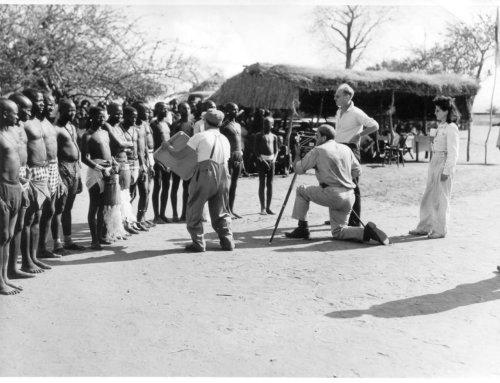
Arch Oboler holding the reflector, Bill on camera. Geoff Hutchinson, Kenya publicity chief and Eleanor
Oboler filming a native dancing group abou to perform.
I was introduced to Geoff Hutchinson, the publicity man for the Kenyan
government. He was from England and had a good accent in his speech.
He had his favorite people in the country that could be interviewed for our
recorders. He also loaned us a pickup truck with a native driver. When
Oboler tried to drive the truck himself, a little incident happened that took
some palavering to straighten out. Neither Oboler nor I could drive the
pickup, it was the domain of the native.
At Nairobi we recorded a traveling Indian vaudeville show. It was a great
deal of fun for me, because I had worked now and then in the Fargo Theater as a stage hand during my
college days. The troupe of vaudeville artists had recently arrived from Bombay, India, and their acts
appealed mainly to the Sikhs of India. We watched the first night’s show from the very front row of the
theater, and recorded the show on tape the second night.
The show had a musical group consisting of a drummer, a sitar player, and a portable reed piano. They
really put out a great deal of music for their small aggregation. The first night I sat next to Alderman Kaparim,
a member of the city governing board. He had arranged the recording session and was interpreting the show
for me. The balcony was loaded with turbaned male Sikhs screaming and hollering at the comedy lines of
dialog performed by the actors. They were speaking in the Hindustani language, and the laughter was
riotous. I couldn’t understand a word, but I got the idea, and it was fun to watch.
The main comedian was dressed like Charlie Chaplin, complete with malacca cane He was dancing around
the pretty girls on the stage, waving the cane, and asking each one if they wanted to sail to America with
him. The lyrics sounded like “Americar, Americar , Americar,” and then they would ask in their language. The
girls all said “NO,” in hindu, until the last one of them said yes to his question, and the couple strutted off the
stage to the beats of the drummer and the screams of laughter from the balcony.
After the show the first night, the alderman invited as to a party for the vaudeville troupe from India. It was
held in a private room at his son’s restaurant. I was overwhelmed by the food served in progressive courses
- I didn’t count how many, but they were all suited to my taste for hot stuff. It was the best meal I had eaten in
Africa to that date. I can now almost taste the curry and other spices that were served that night. It was that
good!
In order to stay in Kenya I had to get a new visa; therefore, I had to go under the University of California
expedition’s jurisdiction. To do that, I had to get a signature from Wendell Phillips, the leader. So I knocked
on his hotel room door in Nairobi. When the door opened, I was looking down the barrel of an army 45
caliber automatic pistol. I don’t know who he was expecting, but he put the gun down when he saw it was
me. That set me wondering, what kind of a dude is this guy? A pistol packing hot shot from the USA? When I
told him what I was after, he signed it and sent me on my way. I was happy to leave his presence.
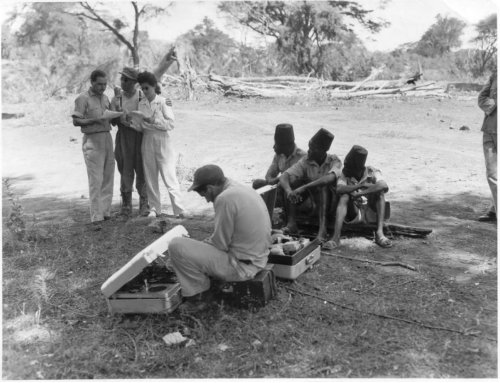
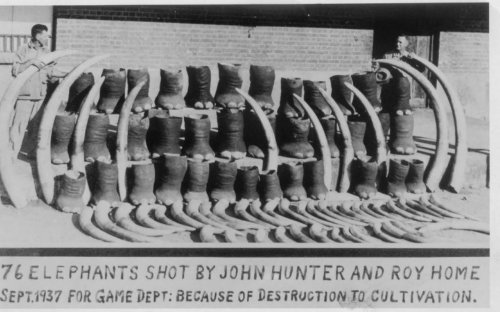
Oboler had done a lot of lining up stories by contacting various government
agencies long before he arrived on the scene. One of them was to go on
safari with one of the government hunters, who oddly enough, was named
John A. Hunter.
Colonel Richie, the white-haired head of the Kenya Goverment game
warden department had this to say about “J.A,” as he called the Scotsman
employee. “He was the biggest ivory poacher we ever had in Kenya, and he
killed hundreds and hundreds of elephants for their tusks. He was good at
his trade.”
“Did you ever catch him?” someone asked.
“No,” answered Ritchie, “we hired him. It was the best way to keep him under our control.”
The stories about “Jock” Hunter, as we called him, were legion. It seemed that every person we asked about
Hunter had another poaching story to tell. The one I heard the most went something like this: “Jock Hunter
used to go on safari in elephant country with a hundred natives as porters. When he got a tusk on each
native’s head, they would march to the coast and sell the ivory to the north bound arab dhow captains who
were looking for cargo.”
So we went on safari with the master hunter himself. We met him in his camp just before dinner in the
evening. He had been waiting for us to arrive, and had another tent set up for Oboler and Geoff Hutchinson,
the Kenya publicity man and our guide, to bunk in. Eleanor was left in the Norfolk Hotel in Nairobi.
“I’m out here to eliminate a rouge leopard that is killing Masai cattle, and that tribe has huge cattle herds.”
With that we sat down to a very nice wild game feed. Hunter was a fine host.
The subject changed during the meal, and we discovered Hunter was writing a book. “I like to write out here
on safari, because I’m usually alone, and it’s something to do in the evenings. It does take a lot of time to
scratch it out in longhand.”
After the meal, I found out I was sleeping in the same tent with Jock. After Arch and Geoff went to their tent,
Jock showed me the book he was writing. As he flipped the pages he read a paragraph here and there. It
was fun for me to listen to his rich Scottish brrrrrrr voice and watch him put a sly smile on his face when
something was funny.
From our dining table, I could see a bunch of vultures circling in the nearby sky . “Jock,” I said, “you haven’t
said anything about those vultures circling over there.”
“I shot a zebra and laid it out over there for bait. I’m after a rogue leopard..”
Almost as on cue, one of the vultures swooped out of the circle, folded its wings and came tumbling out of
the sky. It hit the ground with a heavy thump.
“Did you see that vulture hit the ground, Jock?” I asked.
“I did,” Hunter replied sucking in between breaths on his battered pipe. “That old bird must have eaten one of
my strychnine pills. I planted a bunch of them in the dead zebra’s carcass this afternoon. That happens a lot
with me;. I kill vultures by remote control.”
The next morning at breakfast the talk was about a rifle shot that woke everyone up during the sleeping
period. Jock had the answer. “Yesterday we set up a dumb killer. That’s a rifle trap, baited so the leopard that
is raising ned with the Masai natives’ cattle would trip the trigger and kill himself. That was the shot you
heard. Bill and I saw the critter in the moonlight. He was looking us over as something to eat.”
And that was true. I woke up in the middle of the night when I heard a coughing sound. We had the sides of
the tent rolled up so we could see in most directions. “There, Bill,”whispered Jock from across the tent, “is
the animal I’m hunting this week. That’s a leopard looking us over.
I hope he finds our gun trap before too long.”
The leopard must have heard Jock talking, for he turned and ambled away from out tent area.
It wasn’t long before we heard the gun shot, and Jock called to me, “That’s the dumb killer we set for the
leopard this afternoon. We’ll check it out in the morning. Good night!”
It was all that simple, he had done his job and was ready to move on.
The next morning I wanted to see the gun trap and the leopard, but I was too late, the natives Jock had on
his team had already skinned the leopard and had his hide staked out for curing. “What do you do with the
hide, Jock?” I asked. I had in mind asking for the colorful leopard hide, and thought this was a good time to
start the bargaining.
“The hide now belongs to Kenya government, Bill,” replied Hunter. My plan was shot dead right there and
then.
The gun trap had been made with two posts in the ground just wide enough to let the leopard’s body go
through. On top, between the two posts, was mounted a rifle pointing down at the ground. With other nets
and tree branches, the bait was laid on the ground and fenced in, so the only entry was where the rifle was
aimed.
Oboler was terribly impressed by Jock. He kept talking about him for a long time after that night in Kenya.
I really enjoyed my days with Oboler. Eleanor or El, as we called her, had not gone
on our safari with Jock. She had stayed in Nairobi, so I didn’t really get to know her,
but from then on we had her along on our trips out of the city. She acted as Arch’s
stenographer, and took dictation from him all the time. At night she transcribed the
days dictation to paper on a portable typewriter..
Arch was an original writer and he dictated easily when he was driving the car. He
dictated much of the time, but when something was worth looking at, he didn’t mind
being interrupted by either El or me. He wrote letters, scripts, notes, and everything
in between while we were driving. At first I was a little scared with his driving, but
after a few trips, I felt more at ease with Arch at the wheel. He did some things that
he really believed in. One such thing was blowing the auto horn when going around a blind curve in the road.
In my youth at my grandfather’s ranch five miles west of Gardiner, Montana and bordering on Yellowstone
National Park, we did the same thing when touring in the park. The yellow buses that hauled tourists around
the loop, had a strange sounding warbling whistle that the “Gear Jammer,” that’s Yellowstone employee
jargon for bus driver, always blew when he came to a blind curve. Arch may have picked up the idea from
that source. His brother was the public librarian in Pocatello, Idaho.
Now and then, when Oboler was sleepy he would put me at the steering wheel. But I could see he was not
too sure of my driving. He was a sort of back seat pilot.
“He dictates while driving in California, too,” said Eleanor,”only there he has a secretary, Jerry Klanke, to do
the transcribing. “She’s been with us for three or four years. She puts up with his many whims.”
We were in and out of Nairobi doing the radio recordings for the shows which the Ziv company had
contracted with Arch. I was watching the calendar getting ready to go to Mombasa and catch the Farrell
Lines ship for home. But I was really liking my job with Oboler. We had become very good friends, and he
wanted me to stay with him in the worst way.
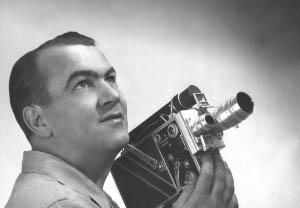
So I did. I took a rain check on the ship ticket, and wrote my mother a letter asking her to air freight my
Eastman Kodak Cine Special camera that I had bought a couple days after I got out of the army. It is the one
in the picture that got me my job with Hallicrafters for the expedition.
As a sidebar to this story, when mother got Northwest Airlines to air freight the camera to me, it was the first
time the Fargo station had shipped a package to Africa. There was a lot of palavering about the rate and all
the documents to get it through customs. The agent of the line, Dick Beaton was a ham a good friend, so he
found out all the necessary things for mother. The camera and its lenses came through Kenya customs with
no problems.
Arch’s agent in New York ordered a heavy duty tripod to take the place of the skimpy on we are using in the
pictures of me filming an Ngoma or dance bit. That came through quickly by air from New York city as did a
shipment of Kodachrome Commercial film that I had been using in my fledgling film making business.
But keep in mind that the main thrust of Oboler’s work was the recordings for a syndicated radio show for
Ziv. Because televison was starting to boom in the United States, the Ziv people kept asking Arch to do more
TV footage for film shows. Radio was starting to loose its popularity.
Oboler had made arrangements with Eastman Kodak to develop the film and check its color, etc. and send
us a cable telling any problems with the quality. So I shot a couple rolls of it and air freighted it the Rochester
EK laboratory for development. I was to send the film to the attention of Ken Mason whom I later got to know
real well. Ken later became the president of the Society of Motion Picture and
Television Engineers, (SMPTE) and a vice president of Eastman Kodak.
So with the camera in hand, we were ready to sail around the African countryside
documenting all kinds of interesting bits of humanity life and struggles. It was what
I thought we were going to do with the so-called commander, but never achieved
any of it much.
With Geoff Hutchinson paving the way for us, we started recording the music of
Africa. I figured out how to read the flickering volume level tube, and using the red
oxide brand new tape from 3M, we started making music memories of the various
tribes in the Kenya area. We kept doing that when we progressed over to
Tanganyika, Rwanda, Urundi, the Belgian Congo and Uganda. After our return to
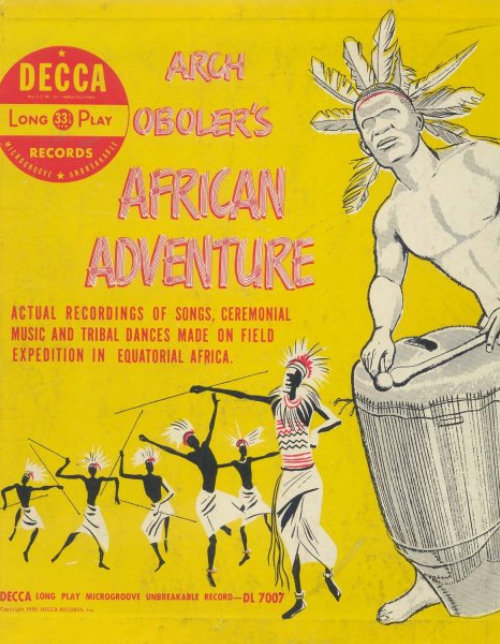
America the music was used in a Capitol long play record, “Arch Oboler’s African
Adventure, DL 7007. From what I could ascertain, we made the first tape
recordings of that part of Africa on location.
CHAPTER 14, Africa after the
firing
Copyright 2003,William D. Snyder
All Rights reserved